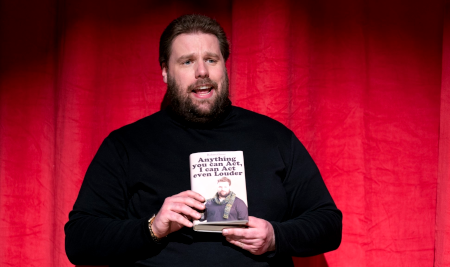
As a fanfiction writer, I spend a lot of time trying to work out exactly what makes a character tick. Who are they? What's important to them? How would they behave in different situations?
It can be a real challenge to characterise the fictional members of the Cornley Drama Society, given that they spend so much of Goes Wrong canon playing other characters. Therefore, I thought I'd see if I could put together a character profile of Robert Grove.
'Are you going to write characterisation guides for the entire drama society?' No. Well, not in this much detail. I'll be honest: I just wanted an excuse to talk at length about Robert Grove, because he's perfect.
Acting
- Theatre is the most important thing in the world to Robert; he will prioritise it over pretty much anything else. He believes with absolute confidence that he is the best actor in the drama society and possibly in the world.
- Although Robert firmly believes that he's God's gift to acting, he is capable of insecurity; when he's drunk on set, he pauses to ask Sandra, 'Am I giving a good performance?'
- Robert is willing to break from the script if following the script would mean extreme discomfort (e.g. refusing a refill on his tea in '90 Degrees'), but he does have a fairly high tolerance in this regard; for example, in 'Harper's Locket', he sits under the leaking roof when the script calls for it. He'll also intentionally go to extremes if he thinks it'll benefit his acting; he prepared for the role of Puck by lying on a slab of ice and being beaten with sticks for seven hours. In short, Robert is prepared to suffer for his art, but he holds the script less sacred than e.g. Chris and Vanessa, so he'll occasionally go off-script to avoid suffering he sees as unnecessary.
- Robert's also prepared to break from the script if following the script would endanger someone else, e.g. when he prevents Vanessa from sticking a meat thermometer into Trevor in 'Harper's Locket'. When he injures a castmate, he'll usually react with some contrition, unless - as in A Christmas Carol Goes Wrong - he was doing it on purpose to steal their role.
(That said, he is... not the most safety-conscious of people. He's done some very ill-advised set climbing, and he did once abandon the Cornley Youth Theatre in the New Forest with knives to prepare them for their upcoming performance of Lord of the Flies; two of the children have never been found.)
- In the above examples, Robert breaks from the script while remaining in character. However, Robert will sometimes break character and speak as himself on the set, most notably when drunk in 'The Spirit of Christmas', but also to express annoyance or exasperation ('I can't answer it, can I?' in 'A Trial to Watch', or 'I don't even want to be in this scene' in 'The Most Lamentable...'), or to argue with Chris.
- It's dangerous to cast Robert in a minor role. If he's dissatisfied with the size of his part, he'll start ad libbing lines, trying to steal other roles or inventing entirely new characters.
- Giving Robert and Chris simultaneous dramatic moments (e.g. scenes where their characters fight) is also risky; they'll start trying to outdo each other, and the production will suffer for it.
- Robert's acting style in general is very loud, very committed and very serious. He's usually solid enough (when he's not actively causing problems in an effort to bolster his role), and he's certainly dedicated, but his tendency to overact means he's best suited to larger-than-life characters. Don't ask him to play children; he is dire.
- Fundamentally, all of Robert's actions proceed logically from the belief that nothing is more important than acting. He's very weird, but he's weird in a way that makes internal sense.
Other interests
- Robert likes to teach! He feels he has a lot of wisdom to impart, and impart it he shall. He runs the Cornley Youth Theatre, he chooses to do an acting workshop for the Cornley Drama Festival, he's written books on acting, and it's mentioned in the stage version of Christmas Carol Goes Wrong that Annie and Max have just finished a six-year acting course under Robert. (This acting course detail isn't included in the published script, but it was brought up in the performance I saw in January 2026.)
- Robert is also Vanessa's life coach, of course, which I think comes from a similar place to his desire to coach people on acting. Basically, Robert is a man who believes he always knows what other people should do, and he'll be happy to tell you what you should do. His efforts to help will probably make things worse, but he's convinced he knows how to solve your issue, and good luck persuading him otherwise.
- Robert cares about money and will take any opportunity to obtain it or avoid spending it. If you drop a ten-pound note in his sight, he's going to pocket it without hesitation; he will not give it back to you unless he's caught. If he's at the pub with others, he'll do his best to weasel out of buying a round of drinks.
- I like to think that Robert enjoys cooking. There's not necessarily a lot to support this - it's just a nice hypothetical detail - but Robert does say in the radio special The Christmas That Goes Wrong that, when he's alone at Christmas, he'll dress as Father Christmas and 'walk about, perhaps make some crêpes', so we do at least know he likes to celebrate a special occasion by cooking for himself. In a way, an interest in cooking would also fit into his love of performing; cooking a meal is a performance, and then you serve it to your audience and get their reactions.
Behaviour
- Robert is loud, dedicated, dramatic and larger-than-life, on stage and off, and he believes that these are essential qualities for an actor.
- Robert is always acting. The world's a stage, and he takes that very literally. He's always looking for opportunities to give some sort of performance to some sort of audience, in the theatre or out of it.
- Robert's speech is always a little too grand. He doesn't speak like a person; he speaks like someone acting from a script. His choice of phrasing tends to be on the elaborate or old-fashioned side, and, unless he's panicking, it's rare for him to hesitate or stumble over his words.
- Robert is always correct. Whatever he says, no matter how ridiculous, he says it with perfect confidence. He'll also refuse to take the blame for anything, because that would mean admitting that his actions were wrong, and he is, as mentioned, always correct.
- Robert is a very sincere man. Everything he does and says comes from a place of earnest belief. He's prepared to lie, but he will lie in the earnest belief that the lie is necessary to, say, improve a performance (e.g. by placing Robert, obviously the most qualified person, in the lead role). His intentions are always genuine. Are they always good? No. He will actively do you harm if you're standing between him and the role he feels he should be playing. But they're always genuine; he's always convinced that he's taking the correct course of action.
- Following on from that thought, Robert expects other people to be genuine in return; he's a trusting person, I think! He doesn't necessarily expect them to be competent, but he expects them to mean what they say.
- Robert is often rude; he's blunt, he says what he's thinking (and, because he tends not to hold other people in high regard, what he's thinking is rarely flattering), and he doesn't give much thought to how his actions might inconvenience others. If you told him he was rude, though, I think he'd be shocked. He employs the surface-level trappings of politeness; he says 'please' and 'thank you' when appropriate. He's concerned with propriety; he bleeps out anything Chris says on the radio that could be interpreted as innuendo, he tries to prevent the audience from seeing Sandra's pants in The Play That Goes Wrong, and he's careful to specify that you can't request 'rude stuff' from the present machine in 'The Spirit of Christmas'. This is not a man who's intentionally setting out to be rude; this is a man with a remarkable natural talent for rudeness, who, in his own head, is behaving entirely appropriately.
- Similarly, Robert can be cruel - he verbally bullies Lucy, he actively attempts to injure Chris in A Christmas Carol Goes Wrong - but I don't think he ever recognises his own actions as cruelty, and if you told him he was being cruel he'd immediately start trying to argue that you're wrong. He's just doing whatever it takes to ensure a good performance! Obviously these actions are entirely reasonable and proportionate. He's constantly focused on the end goal of 'successful play' and fails to register that the step he's taking in pursuit of that is 'hurt person'. The people around him end up just as hurt, of course! But, for characterisation purposes, I think it's important to remember that Robert isn't a cackling villain; he's an inconsiderate friend.
- Although Robert usually harms people out of lack of consideration rather than malice, he's not wholly above a bit of malice; he does give Chris a part calculated to humiliate him in Summer Once Again! (Although he also includes a later scene in which his own character reconciles with Chris's, which is an interesting detail if, like me, you think Robert wrote Summer Once Again himself.)
Relationships
These are fairly broad notes on how Robert approaches relationships in general, rather than digging into Robert's relationships with specific people, because, boy, we do not have the time to pick apart whatever's going on between him and Chris.
- Robert has a romantic streak. He values affection in a relationship (he insists that his relationship with Chris's mother is 'hardly surprising' because Chris's family aren't affectionate enough with her), and he really wants to make sure that, at his romantic getaway with Chris's mother, there are flower petals on the bed.
- As Robert has slept with both Dennis and Chris's mothers, I think we can probably conclude that he's interested in older women.
- Robert enjoys being seen as a father figure; he says 'thank you' when Dennis calls him 'Dad', and then starts trying to pressure Chris to do the same.
- I don't think Robert's a miserable person, but I do think he's a little lonely. He comments in The Christmas That Goes Wrong that he likes to dress up as Santa because 'he's a happy man; certainly happier than I am', and he told Dennis and his mother that he had 'nowhere to go' after his Christmas Day Nativity performance, presumably angling (successfully) to be invited back with them. We also know from 'The Spirit of Christmas' that it hit him pretty hard when his partner Denise left him.
- Robert likes spending time with the drama society socially! After his breakup leaves him sleeping in his car, he ends up living with Dennis. In the televised version of A Christmas Carol Goes Wrong, he's cheerfully talking to other members of the society at Dennis's birthday party; in the stage version, he's the character fighting hardest for an afterparty. (Again, this is a detail that I saw in performance but that isn't included in the published script.) The Christmas Carol performance I saw also included a few moments of affectionate body language between Robert and other members of the drama society (particularly Annie): Robert and Annie hugged enthusiastically when Robert came in to audition, Robert put his hands protectively on Annie's shoulders when Chris snapped at her, and Robert spun Chris around in a hug when the review came in.
Robert's best quality as a friend: he will give generously of his time and effort to fix your problem, or at least to fix what he has decided is your problem. This... may not actually be helpful, but it will at least be well-intentioned.
Robert's worst quality as a friend: he will sleep with your mother, insult your acting and throw you under the bus to play the Dane, and he won't even understand why you're annoyed with him afterwards.
In short, Robert is an egotistic and outspoken man with a passion for theatre, an intense sincerity, a vast capacity for self-absorption, a need to be important, a desire for company and an absolute lack of self-awareness. He's relentlessly loud and dramatic. He will refuse to apologise if he doesn't think he's in the wrong, and he will never think he's in the wrong. He's a nightmare. I love him.